
SugarAI vs Salesforce for ERP Users: Which CRM is the Better Fit
Choosing the right CRM is an important decision for any business, but if you’re already using an ERP system, there’s even more to consider. Your CRM shouldn’t just help manage customer relationships, it should work seamlessly with the systems you already rely on. By connecting customer, product and operational data, an integrated CRM creates a single source of truth, helping teams work more efficiently and make better-informed decisions.
SugarAI (formerly SugarCRM) and Salesforce are both powerful CRM platforms, but they’re designed with different priorities in mind. Salesforce is renowned for its enterprise ecosystem and extensive functionality, while SugarAI has built a strong reputation for flexibility, ERP integration and supporting businesses with more complex operational processes.
So, which CRM is the better choice for ERP users?
SugarAI vs Salesforce for ERP users
ERP integration
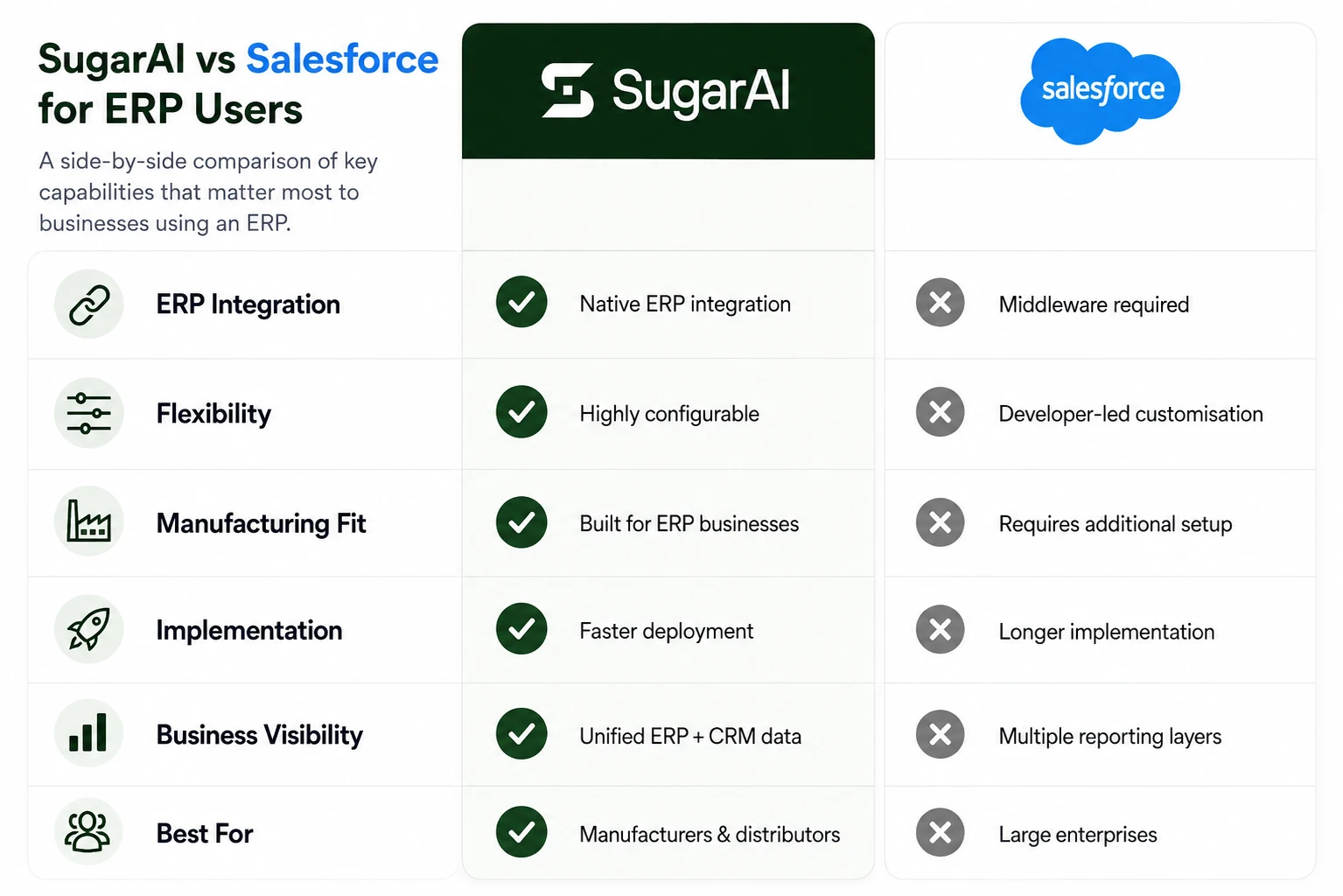
For ERP users, integration is often the biggest deciding factor. SugarAI is built to work alongside your ERP rather than replacing it. Customer records, pricing, orders, invoices and other operational data can be brought together into a single CRM, reducing manual work and giving teams a more complete view of every account.
Salesforce also integrates with many ERP systems, but these integrations often rely on middleware or custom development. While powerful, they can introduce additional complexity and ongoing maintenance.
Flexibility & business processes
One of SugarAI’s biggest strengths is that it adapts to your existing processes. Whether you need bespoke workflows, custom modules, approval stages or industry-specific fields, the platform can be configured to reflect how your business already operates, rather than forcing teams into a standard way of working.
Salesforce is also highly configurable, but tailoring the platform often requires specialist expertise, making changes more time-consuming and potentially more expensive over time.
Manufacturing & distribution
For manufacturers and distributors, a CRM needs to do more than manage contacts, it needs to support day-to-day operations.
SugarAI allows teams to work with high-level ERP information such as order history, pricing, stock availability and service records directly within the CRM. This helps sales, customer service and operations work from the same information, improving collaboration and reducing unnecessary admin.
Salesforce can support these industries too, but businesses often rely on additional applications or custom integrations to achieve the same operational visibility.
See how UK leading manufacturer, Geosynthetics, integrated their ERP into SugarCRM, and how this benefited their day-to-day business.
Implementation & scalability
SugarAI offers the flexibility to start with the functionality you need today while providing room to expand as your requirements evolve. Whether you’re adding users, departments or additional ERP processes, the platform can grow alongside your business without requiring a complete rethink.
Salesforce is renowned for its scalability, but larger implementations can involve longer projects, greater complexity and higher ongoing administration, all adding time at every step of the project.
Predictive analytics & smarter decision-making
SugarAI houses a feature called Sugar Predict, which analyses CRM and ERP data together to help identify cross-sell and upsell opportunities across your customer base. By combining customer interactions with information such as purchasing history and product data, businesses can make smarter, data-driven decisions without relying on guesswork.
Salesforce also offers AI-powered insights through its Einstein platform, but these capabilities often require additional products, licensing or configuration. For businesses looking to turn connected ERP and CRM data into practical recommendations, SugarAI provides a powerful yet straightforward solution.
Feature comparison
Pricing & total cost of ownership
While pricing is always an important consideration, it’s worth looking beyond the monthly licence cost. Implementation, customisation, integrations and ongoing administration can all have a significant impact on the overall cost of your CRM.
(All prices are in dollars but are available in £/GBP)
SugarAI
Standard: From $59/user/month
Advanced: From $85/user/month
Premier: From $135/user/month
15-user minimum (annual subscription)
Salesforce
Starter Suite: $27/user/month
Pro Suite:$108/user/month
Enterprise: $188/user/month
Unlimited: $376/user/month
Although Salesforce offers a lower first-tier entry price, organisations often invest in additional products, integrations, and specialist development as requirements become more complex. SugarAI’s pricing starts higher, but many of the capabilities needed by ERP-driven businesses are included in the platform, helping reduce complexity and overall cost of ownership over time.
Which CRM is best for ERP users?
Both SugarAI and Salesforce are capable CRM platforms, but they’re designed with different organisations in mind.
If your business requires a highly customised enterprise platform with extensive capabilities and has the resources to manage a larger implementation, Salesforce is a good option.
However, if your ERP is central to your day-to-day operations, SugarAI is often the better long-term fit. Its flexibility, closer ERP integration and ability to support complex business processes without unnecessary extras make it particularly well suited to manufacturers, distributors and organisations that rely on connected business systems.
If you’d like to see how SugarAI could work alongside your ERP system, book a free initial consultation to understand what enable.services can offer your business day-to-day. Fill out this form, or email sales@enable.services to find out more.