ERP and CRM Integrations: Connecting NetSuite, Epicor, and More
Every growing business eventually hits the same digital wall. Your sales team is operating at lightning speed inside your CRM, while your operations and finance teams are anchoring the business inside your Enterprise Resource Planning (ERP) system.
The problem? Most ERPs don’t play nicely with CRMs straight out of the box. In fact, IDC research shows that companies can lose 20% to 30% of their revenue annually due to inefficiencies and missed opportunities caused by data silos.
While the benefits of CRM and ERP integration are obvious, slashing admin time, eliminating data silos, and improving customer experience, the reality of how you achieve them depends entirely on the specific software you are running.
A one-size-fits-all plugin rarely cuts it when you have custom workflows. That’s why at enable.services, we build bespoke bridges between your specific systems. If you’re wondering what CRM integrations look like in the real world, here is how we connect some of the most popular ERPs on the market to create a seamless, bidirectional flow of data.
1. NetSuite CRM integrations
NetSuite is a powerhouse for managing financials, supply chains, and inventory. However, if your sales reps can’t see live NetSuite inventory data inside their CRM, they risk selling products you don’t have.
By integrating NetSuite with your CRM, we ensure that the moment a deal is won, the order is automatically pushed into NetSuite for immediate processing. The flow goes both ways, billing status and shipping updates are pushed back into the CRM so your sales team is always in the loop.

We helped Geosynthetics, the UK's largest independent geosynthetics supplier, seamlessly connect their NetSuite ERP with their SugarCRM system. The result? They completely transformed their complex quoting processes and reduced their quote turnaround time down to just 14 days.
2. Epicor CRM integrations
Epicor is incredibly popular in the manufacturing and distribution sectors, industries where precise costing and real-time inventory are non-negotiable. An Epicor and CRM integration eliminates the need for your sales team to manually calculate costs or chase down operations for stock checks.
You can automatically sync product catalogues, price lists, and customer credit limits directly into your CRM, empowering your reps to generate accurate quotes in seconds.

Before integration, the team at Alcohols Limited spent an hour manually keying just six orders into their disparate systems. After we integrated their CRM with Epicor, that exact same task dropped from 60 minutes to just three minutes.
3. Microsoft Dynamics 365 Business Central
Many mid-market businesses rely on Business Central to keep their operations ticking. But when sales and marketing data is kept separate, you miss out on crucial forecasting insights.
Integrating Business Central with your CRM means your finance team doesn’t have to chase sales for end-of-month figures, and marketing can actually see which campaigns are driving true ROI based on actual invoiced revenue, not just “closed won” deals.
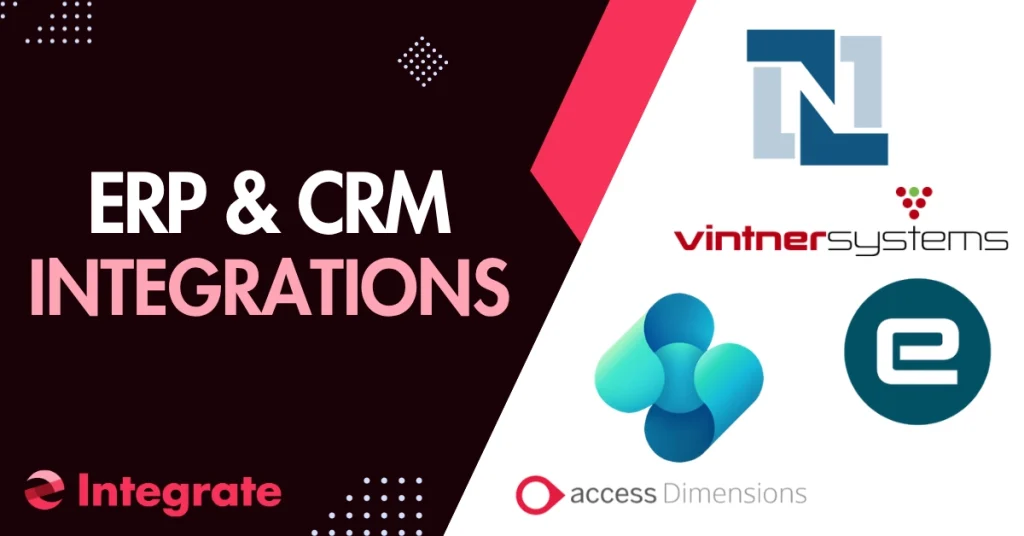
4. EFACS, Access Dimensions, Vintner, and Niche ERPs
Not every business uses the “big three” ERPs, and you shouldn’t be penalised for using specialised software like EFACS, Access Dimensions, or Vintner.
Off-the-shelf connectors usually ignore these niche platforms, but a bespoke integration taps directly into their APIs to ensure your highly specific, industry-tailored workflows remain intact while still communicating perfectly with your CRM.

Manufacturing firm Rotalink relied on EFACS. By building a custom connection to their CRM, we eliminated four to five hours of weekly manual quote costing per salesperson. That single integration saves them around £34,000 a year in labour costs.
Why bespoke integrations beat "out-of-the-box"
Ultimately, if the thought of connecting your systems feels overwhelming, you certainly aren’t alone. According to MuleSoft, over 80% of IT leaders report that data silos and integration challenges are the biggest hurdles holding their business back from digital transformation.
When faced with that frustration, it’s incredibly tempting to look for a quick-fix plugin just to get your CRM and ERP talking. But taking the easy route usually comes with a hidden cost: out-of-the-box integrations force you to change your hard-earned business processes to fit the limitations of the software.
A bespoke CRM and ERP integration does the exact opposite, it bends the software to fit the way your business already operates.
Your people shouldn’t be the integration. If your team is still wasting hours copying customer details, rekeying orders, or checking spreadsheets across multiple disconnected systems, it’s time to stop settling for workarounds. Check out enableIntegrate by enable.services today, and build a smarter workflow that actually empowers your team.